You can calculate your net income (the money that you have earned at the end of the day) by subtracting your expenses from your revenue. It’s possible that your net income will demonstrate a net loss when your business is in its early stages. Almost all businesses use the double-entry accounting system because, truthfully, single-entry is outdated at this point. For example, if a business signs up for accounting software, it will automatically default to double-entry. The income statement is also referred to as a profit and loss statement.

Accounting Equation and the Balance Sheet
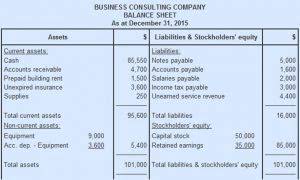
If the total assets calculated equals the sum of liabilities and equity then an organization has correctly gauged the value of all three key components. However, if this does not match then organizations need to check for discrepancies. Utilizing advanced accounting software enables organizations to proactively identify and manage anomalies. Accountants use debits and credits to record transactions, but it is also important to understand how they impact assets, liabilities Debt to Asset Ratio and equity.
- The creditors provided $7,120 and the company’s stockholders provided $10,080.
- The dollar amount of assets on the left side of the equation must equal the sum of liabilities and equity on the right side.
- As the fintech industry provides advanced technology applications, memorizing elements of the accounting equation will become obsolete.
- Other expenses, such as selling, general, and administrative (SG and A) expenses, are subtracted to arrive at net income.
- In other words the expanded accounting formula shows retained earnings is the link between the balance sheet and income statement.
What the Basic Accounting Equation Means
- Use our coaching to learn the WHY behind each answer and deepen your understanding of the topic Accounting Equation.
- Debits and Credits are the words used to reflect this double-sided nature of financial transactions.
- Our Explanation of Accounting Equation (or bookkeeping equation) illustrates how the double-entry system keeps the accounting equation in balance.
- Gross profit reflects the financial success of your products or services by reflecting how much money remains after production costs.
- Many businesses today use accounting software to manage their financial records.
Other expenses, such as selling, general, and administrative (SG and A) expenses, are subtracted to arrive at net income. The following are some of the most frequently used accounting formulas. accounting formula This list is not comprehensive, but it should cover the items you’ll use most often as you practice solving various accounting problems. Accountingo.org aims to provide the best accounting and finance education for students, professionals, teachers, and business owners.
- Owner contributions refer to the amount of money that the owner has invested in the business.
- This is consistent with financial reporting where current assets and liabilities are always reported before long-term assets and liabilities.
- As you can see from the accounting equation itself, there are three elements that make up the whole formula — assets, liabilities and equity.
- Although stockholders’ equity decreases because of an expense, the transaction is not recorded directly into the retained earnings account.
- For new businesses, the accounting equation is an essential tool for keeping track of their financial position.
More Accounting Equation Resources

The accounting equation is especially important for corporations, as it helps them to keep track of their financial position and make informed decisions. In a corporation, the equity component of the accounting equation represents the shareholders’ equity. This means that the accounting equation is used to determine the value of the company that is owned https://www.bookstime.com/ by the shareholders. This equation is used to ensure that the balance sheet remains in balance. The balance sheet is a financial statement that provides a snapshot of a company’s financial position at a specific point in time.

- Calculating this not only completes the balance sheet but also aids in understanding the owner’s residual interest in the company.
- A thorough understanding of the engineering behind financial statements is essential for a valuation assignment or an M&A transaction.
- Maintaining Accurate BooksIt ensures all transactions are recorded properly, preventing accounting errors and fraud.
- Understanding how to use the formula is a crucial skill for accountants because it’s a quick way to check the accuracy of transaction records .
- The accounting balance sheet formula makes sure your balance sheet stays balanced.
- Business owners with sole proprietorships and small businesses that aren’t corporations use Owner’s Equity.
Understanding how each report interacts ensures a complete financial picture, reinforcing trust in the numbers that drive business success. The expanded equation still follows the same fundamental rule as the basic equation, but it provides a more detailed breakdown of equity. A strategic approach to your financial equation could make all the difference. Generally Accepted Accounting Principles (GAAP) are built on the accounting equation’s foundations, making it essential for regulatory compliance. Whether you’re just starting out or brushing up on accounting basics, mastering this equation is a must for sound financial management.